How economic changes may be affecting families differently
This blog continues our reflections on the results of a survey that the HOPE National Resource Center team, in collaboration with the American Academy of Pediatrics, Prevent Child Abuse America, and the CDC (Centers for Disease Control and Prevention), commissioned with YouGov.com in November of 2020, asking a national sample of parents and caregivers about their experiences with their children since March of 2020. The project is intended to help inform providers about how to help parents and families.
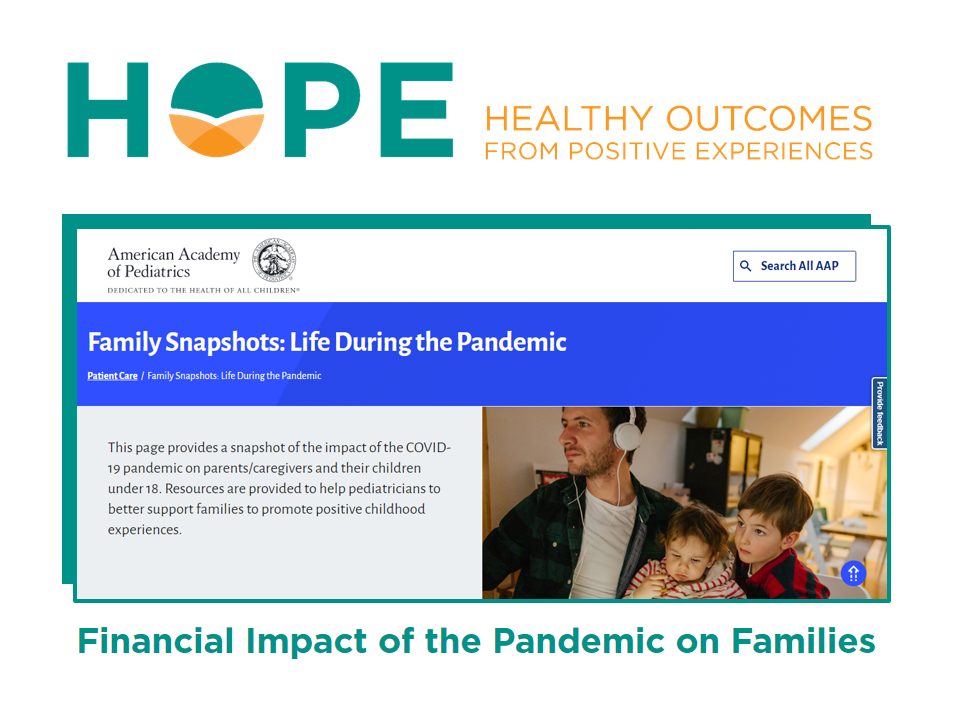
Using information from this questionnaire, the American Academy of Pediatrics has released a series of reports on Family Snapshots: Life During the Pandemic. The second snapshot highlights how economic changes may be affecting families differently.
Family financial stresses increased during the pandemic. Many (38%) parents / caregivers reported that their household finances were worse since the start of the pandemic. This is partially due to employment change: over 40% of parents who had been employed part- or full-time before March 2020 reported that they had a reduction in working hours since then. This included those who were laid off or otherwise had hours reduced by an employer. In addition, many respondents reduced their working hours to care for their children. In fact, 1 in 17 men (6%) and 1 in 6 women (13%) reduced their hours to care for children or family after March of 2020. From these data, it is clear that parents made the difficult decision to reduce work in order to meet family needs.
The second of the Four Building Blocks of HOPE – safe, stable, equitable environments to live, learn, and play – may be directly jeopardized by conditions that negatively affect family financial stability. However, increases in government programs that assist families help maintain these environments for many children. Nearly half of parent respondents (49%) had received some type of financial support since the beginning of the pandemic, ranging from health insurance to food stamps to income support. Access to these services may explain the difference in parents who experienced job loss (50%) and those who reported that their household finances had been impacted negatively (38%). In fact, government assistance programs reduce child poverty rates [1]; the growth of these programs helps ensure safe environments for children.
The newly enacted American Rescue Plan Act of 2021 includes specific provisions for parents and children. Families with children under the age of 18 can qualify for increased child tax credits. To ensure that the low-income families benefit, these tax credits are fully refundable. Additionally, approximately $176 billion in funds going to education and school reopening, and extension of unemployment benefits to September of 2021, are likely to reduce child poverty rates. However, children in families with immigration concerns may be left out: the Act makes little provision for taxpaying undocumented immigrant families, limiting their access to safe and equitable environments to live, learn, and grow.
As further information is released following the future rounds of this questionnaire, we encourage you to follow releases:
- AAP Snapshots: Family closeness during the Covid-19 pandemic
- AAP Snapshots: Stressors placed on families with children with special health care needs
- AAP Snapshots: Parental concerns about children falling nehind during the Covid-19 pandemic
- AAP Snapshots: In the words of parents
- APP Snapshots: One year summary of survey responses
[1] AAP COUNCIL ON COMMUNITY PEDIATRICS. Poverty and Child Health in the United States. Pediatrics. 2016;137(4):e20160339