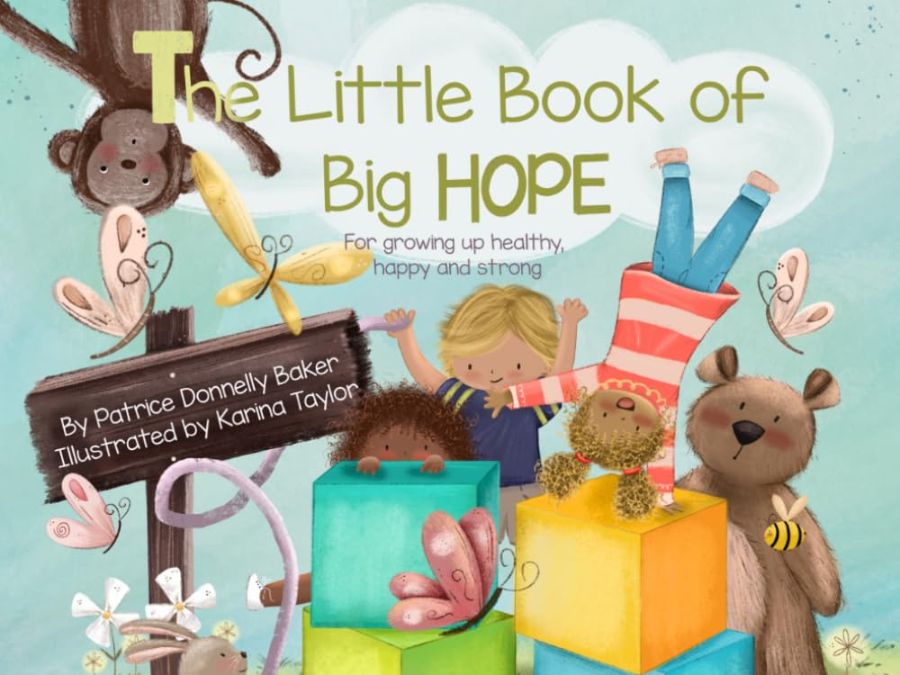
Finding a new way to reach children and families
Patrice Baker, a HOPE Champion who works as an interventionist at an elementary school in Southampton, New Hampshire, identified an opportunity to disseminate the HOPE framework in a new way. She was thinking about the challenges of gathering a group of parents together for a training or a workshop — the logistics involved in providing childcare, offering food, motivating tired parents — and trying to figure out other pathways to reinforce HOPE principles with parents and caregivers.
The idea came to her during a discussion with staff at the HOPE National Resource Center and other HOPE Facilitators.
“Someone was like, ‘We don’t have a children’s book. It’d be so great if there was [one].”
She was immediately inspired. “It felt like, “Gosh, [imagine] a children’s book that we could give to parents that would teach them about the framework, but engage the kids at the same time.’”
Baker has had multiple professional roles since she was introduced to the HOPE framework in 2020, and in each of them she has used the HOPE framework in how she thinks about her work. She realized she wanted to translate that into something concrete and tangible, and with the support of HOPE staff, began writing.
What is in The Little Book of Big HOPE
The Little Book of Big HOPE is an interactive picture book that engages adults and children in conversation as they explore the HOPE framework, which centers on the Four Building Blocks of HOPE, or key types of positive childhood experiences (PCEs) children need to thrive. The book encourages learning and connection as children and adults celebrate PCEs. It includes a letter to adults explaining the HOPE framework, and a project idea to do at home.
A critical aspect of her approach was making the book interactive and accessible to children. To that end, she decided to use animal behaviors as examples for each of the Building Blocks.
“Each Building Block is followed by a page that starts with, ‘Guess what, did you know that baby elephants need grown-ups who care for them too?’ or something like [that].”
She simplified concepts like PCEs so that children would understand them. The text on one page reads: “Sometimes it’s easier to spot the negative things. But our lives are better when we see the positives. The more we practice, the better we get.” And then it encourages the reader to try it out: “Let’s practice! Put on your pretend strength glasses. Look at someone in your family. Tell them three great things you see.”
Another component of the book that was important to Baker was to make it relatable to a wide audience.
“I wanted the book to have lots of different ages of people, grandparents, parents, children, and lots of different colors of people, and hairstyles, and settings. We live in rural New Hampshire, but there’s cities in the book.”
How to use this book with the children and families you work with
Baker has big dreams for how this book can be used in her field. One is when home visitors go out to meet families.
“I could see them bringing this book on a first visit, because reading this book together with a family will teach you a lot about the family. Who are their people? Who are their places? What do they do for fun?”
She points out that not everybody grows up in a house where they were read to, where it’s natural to do these back and forth interactive activities that the book offers. In that sense, it also serves a literacy coaching function.
She can see the book in libraries, the waiting rooms of doctor’s offices, family resources centers, and schools. It can be used by early intervention providers who bring the book to a home visit and read it with the parent and child. It can be used during a workshop for parents and caregivers, even instead of a slide deck. And she suggests Including the book in “Welcome” Bags or use it as a “give away” at events so that it reaches far and wide.
Ultimately, these efforts require funding. And that’s Baker’s next step.
“[It excites me a lot to try to find funders who understand the value of this, and then let’s get this book into the hands of parents.”