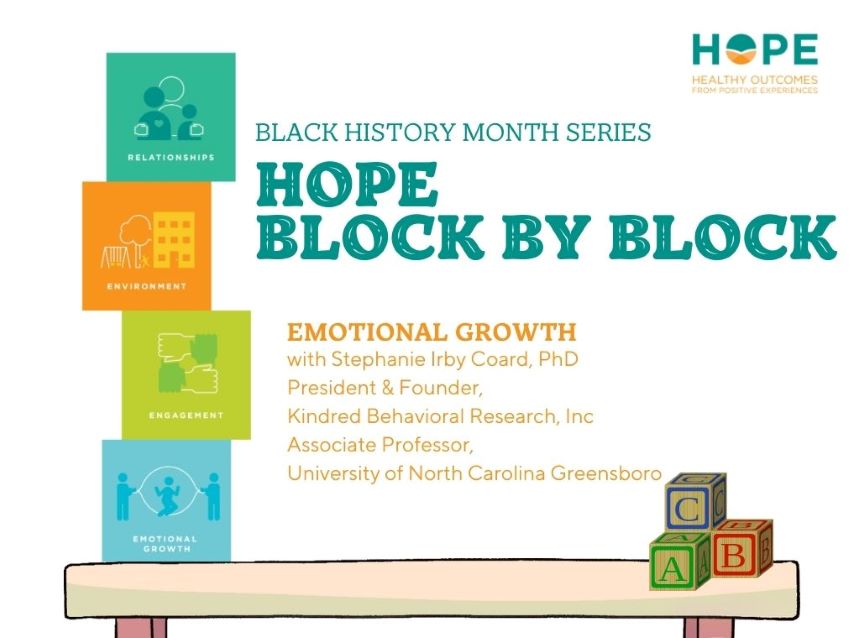
Stephanie Irby Coard, PhD on how to promote emotional growth with Black children and families
All children need positive childhood experiences (PCEs). The HOPE National Resource Center believes that every child in each community should have access to the key types of PCEs that we call the Four Building Blocks of HOPE: safe and supportive relationships that are critical for children to develop into healthy, resilient adults; safe, stable, equitable environments to live, learn, and play; opportunities for social and civic engagement to develop a sense of belonging; and opportunities for emotional growth.
The HOPE National Resource Center believes that Black history is American history. This year, we honor Black History month with a vlog series, HOPE Block by Block, where we highlight the impactful work of Black practitioners, scholars, researchers, and community activists during the month of February. This series shares impactful ways for organizations and communities to promote access to each of the Four Building Blocks for Black and African American families.
Our guest, Stephanie Irby Coard, PhD, addresses the Building Block of emotional growth, which are opportunities where children and youth experience difficult events and emotions and feel supported through the experience. Dr. Coard is an Associate Professor of Human Development and Family Studies at the University of North Carolina Greensboro, where she examines racial, ethnic, and cultural influences on youth development and family functioning and the development and implementation of culturally relevant evidence-based practices focused on African American families and communities. Dr. Coard is also Founder and President of Kindred Behavior Research, where she bridges science and culture to promote mental health and well-being among children, families, and communities of color.
Dr. Coard is creator of the Black Parenting Strengths and Strategies (BPSS) series. BPSS is an evidenced-based program that aims to promote cultural, social, and behavioral health among African American families. The BPSS program has been developed to incorporate the most successful strategies used by parenting and child development specialists, while drawing on the strengths, unique parental strategies, and processes inherent in African American families (e.g., racial socialization). BPSS programs are: BPSS Assist to Resist, BPSS Child, BPSS Parent and BPSS- Racialized Short.
Dr. Coard also helped produce a video series called One Talk at a Time, which helps parents talk to their children about race and ethnicity. In the video below, Dr. Coard shares her work in promoting the building block of emotional growth in communities of color through racial and ethnic socialization and the importance of this work for all individuals, children, and families.