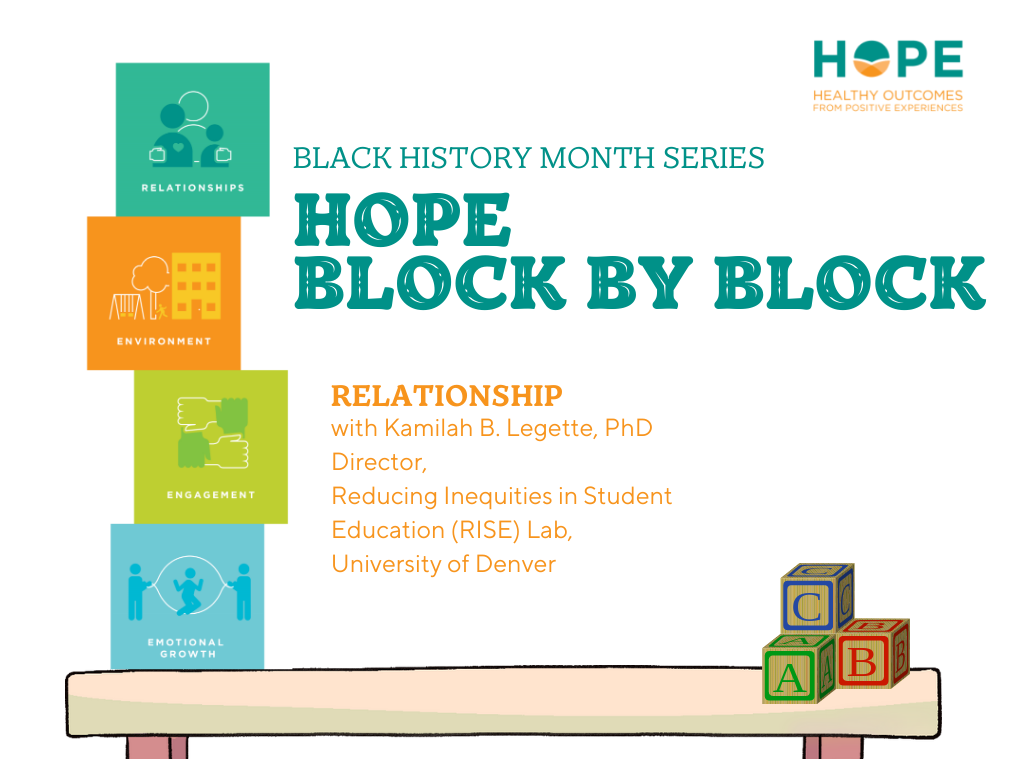
Kamilah B. Legette, PhD on creating positive relationships between educators and students
All children need positive childhood experiences (PCEs). The HOPE National Resource Center believes that every child in each community should have access to the key types of PCEs that we call the Four Building Blocks of HOPE: safe and supportive relationships that are critical for children to develop into healthy, resilient adults; safe, stable, equitable environments to live, learn, and play; opportunities for social and civic engagement to develop a sense of belonging; and opportunities for emotional growth.
The HOPE National Resource Center believes that Black history is American history. This year, we honor Black History month with a vlog series, HOPE Block by Block, where we highlight the impactful work of Black practitioners, scholars, researchers, and community activists during the month of February. This series shares impactful ways for organizations and communities to promote access to each of the Four Building Blocks for Black and African American families.
Our guest, Kamilah B. Legette, PhD, addresses the Building Block of relationships, which are safe and supportive peer-to-peer, child-to-parent, or non-parent-adult-to-child relationships. Dr. Legette is an assistant professor. Dr. Legette is an assistant professor in the Psychology Department and director of the Reducing Inequities in Student Education (R.I.S.E.) Lab at the University of Denver. Her interdisciplinary research investigates ways individual and institutional racial biases impact youth academic performance and social-emotional and identity development. The goal of this work is to uncover processes contributing to racial disparities in school that will inform effective interventions, school policy changes, and educators preparation programs that will optimize healthy development and achievement in youth. In the below video, Dr. Legette talks about ways educators can form more meaningful relationships with students of color.