Wendy Ellis, DrPH on promoting safe and supportive environments
All children need positive childhood experiences (PCEs). The HOPE National Resource Center believes that every child in each community should have access to the key types of PCEs that we call the Four Building Blocks of HOPE: safe and supportive relationships that are critical for children to develop into healthy, resilient adults; safe, stable, equitable environments to live, learn, and play; opportunities for social and civic engagement to develop a sense of belonging; and opportunities for emotional growth.
The HOPE National Resource Center believes that Black history is American history. This year, we honor Black History month with a vlog series, HOPE Block by Block, where we highlight the impactful work of Black practitioners, scholars, researchers, and community activists during the month of February. This series shares impactful ways for organizations and communities to promote access to each of the Four Building Blocks for Black and African American families.
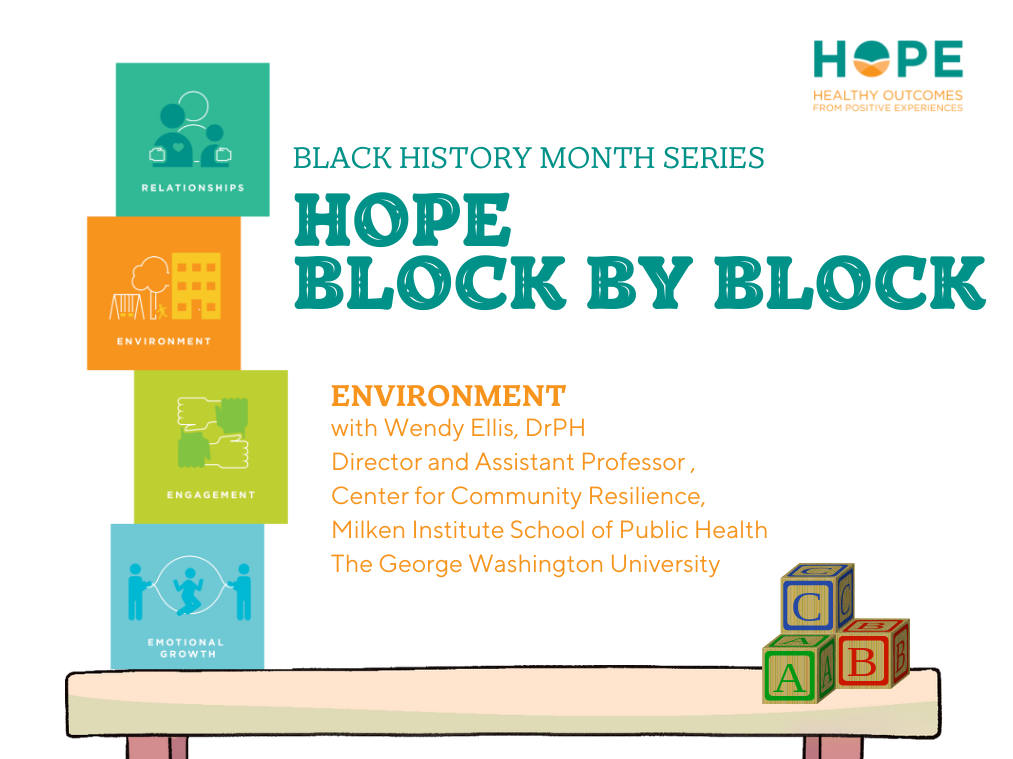
Our guest, Wendy Ellis, DrPH, addresses the Building Block of environments, which are safe places where children can live, learn and play. Dr. Ellis is the Director of the Center for Community Resilience. The Center for Community Resilience seeks to improve the health of communities by enabling partnerships to connect policy, program, and practice. These partnerships will address Adverse Childhood Experiences (ACEs) in the context of adverse community environments as described in Dr. Ellis’ “The Pair of ACEs”. The Pair of ACEs focuses on equity and prevention and has influenced local initiatives, programs, public health initiatives, and local, state and federal policy. Building Community Resilience networks have successfully used the Pair of ACEs to lead systems and policy change to address long-standing economic, social, and health disparities by partnering with community, integrating service delivery, and building political will for change.
The Building Community Resilience (BCR) collaborative and networks are implementing the BCR process based on Dr. Ellis’ research about designing a strategic approach for multiple systems to align resources, programs, and initiatives with community-based partners to address adverse childhood experiences, and environments. The BCR approach provides a standard process to reach a custom solution to promote resilience in communities by improving access to supports and buffers that help individuals and communities thrive. The BCR process has been adopted by governmental agencies and coalitions in countries across the globe.
Dr. Ellis will be delivering the Keynote Address at the Second Annual HOPE Summit – Growing HOPE on March 8, 2022. Hear Dr. Ellis talk more about her work and be the first to learn about the new Resilience Tree Tool.