

Section 1: Assess readiness


Is this section for me?
We highly recommend that each organization looking to implement the HOPE framework starts here. However, some organizations have already done a lot of work to assess their readiness. Use these questions to see if you have a clear understanding of your readiness:
- Do we understand leadership’s level of support and alignment with the HOPE framework?
- Do we understand staff capacity, well-being, and the emotional climate of the organization?
- Do we know who is interested, where there is the most energy, and how HOPE fits into other aspects of our current organization and work?
- Do we know who is already championing the HOPE framework (e.g. HOPE Facilitator, HOPE Champion) within our organization or community and/or where there is work to do?
If so, you’ve completed this step and can move on to the next section, Look at your data, or you read this section to make sure you are happy with the readiness information you have gathered.
Introduction to assessing your readiness
Readiness for implementation is about understanding how prepared an organization is to move an improvement effort forward in a realistic and sustainable way – right now. Before launching a quality improvement effort, it helps to pause and consider whether the conditions are appropriate to support meaningful change. This includes leadership support, staff capacity, available resources, and competing priorities.
Assessing readiness upfront isn’t about lowering expectations or questioning commitment. Teams can care deeply about improving outcomes and still face real constraints that shape what’s possible in the moment. Taking time to name those realities helps teams design improvement efforts that fit their current context, rather than an idealized one. This leads to change that is more manageable and more likely to last.
How this step fits into the larger QI process
Readiness comes at the very beginning of the quality improvement process, before teams begin clearly defining what they want to work on or how they will measure progress. It serves as a grounding step that helps teams focus their efforts and set a level of ambition that matches their current capacity.
Having a clear sense of readiness supports better decisions about what feels feasible right now, how quickly change can realistically happen, and where there is enough energy or influence to begin. Without this grounding, teams may move too quickly into planning and set goals that don’t fully reflect day-to-day realities. When readiness is considered intentionally, teams are more likely to define goals that are clear, focused, and manageable. This creates space for learning rather than frustration.
Readiness also shapes how teams involve others in the work. For example, limited leadership buy-in or support may signal a need to invest early in relationship-building or shared understanding, while limited staff capacity may point to starting with smaller, more manageable changes rather than full-scale implementation.
Guidance and questions to ask
Readiness has more than one dimension. While every organization’s context is different, there are a few common areas that tend to shape how easily an improvement effort can move forward.

Leadership support and alignment with the HOPE framework
- How familiar are leaders with the HOPE framework and its emphasis on strengths, relationships, equity, and well-being?
- In what ways does the HOPE framework align with (or challenge) how the organization currently approaches children, families, or communities?
- Are leaders open to shifting from current practice to an effective strength-based approach aligned with the HOPE framework?
- Do leaders feel that HOPE implementation adds to existing strengths-based program concepts?
- Who has the authority to support or approve changes related to policies, workflows, or resource use that may be needed to support HOPE-Informed practice?
- Is there leadership understanding and buy-in around the potential organizational benefits of adopting the HOPE framework?
Leadership support does not require constant involvement, but it does require shared understanding and alignment, especially when HOPE implementation may influence how success is defined or how staff engage with families.

Staff capacity, well-being, and emotional climate
- What knowledge or training do staff already have about the HOPE framework or other strengths-based frameworks?
- How are staff currently supported in managing stress, emotional labor, and exposure to trauma?
- To what extent does HOPE-Informed work feel like a natural extension of current practice, rather than an added expectation?
- Are there opportunities for this work to simplify, streamline, or reframe existing efforts rather than adding more?
The HOPE framework emphasizes emotional growth and well-being for both families and staff. Readiness includes being honest about what teams can realistically take on while protecting emotional health.

Engagement, energy, and shared purpose
- Who or what has sparked interest in the HOPE framework at this moment?
- Where are you already seeing curiosity, openness, or momentum around strengths-based or relational approaches?
- How does this work connect to staff’s understanding of their role or reasons for choosing this field?
- How might the HOPE framework help reconnect people to meaning, especially if morale or motivation has been strained?
Sustained engagement often comes from shared purpose. Work aligned with the HOPE framework is more likely to take root when it resonates with what people already care about.

Organizational environment and context
- How well does the current organizational environment support relational, strengths-based practice?
- Are policies, procedures, or documentation systems primarily focused on risk, compliance, or deficits? Is there room to notice and build on strengths?
- What other priorities or pressures (funding, accreditation, staffing changes, crises) might shape the pace or scope of HOPE implementation?
- Are there environmental factors (e.g., physical space, schedules, systems) that could either support or limit this work?
HOPE implementation happens within real systems. Understanding the broader environment helps teams choose an approach that fits their current context.

Influence, relationships, and partnerships
- Who inside the organization is already modeling practices aligned with the HOPE framework formally or informally?
- Who else needs to be engaged so that this work feels credible and supported?
- Are there existing partnerships, internal or external, that could support HOPE implementation efforts?
- Where might trust or shared understanding need to be strengthened before broader implementation can occur?
- Who in our organization has already attended an Introduction to HOPE training?
Do we have a relationship with a certified HOPE Champion, or would we need to be connected with one to support our implementation efforts?
Paying attention to influence and connection helps teams build momentum in thoughtful, sustainable ways.
Tools and templates
Here are a few additional, optional, tools that might help as you work through the Guidance and Questions to Ask.
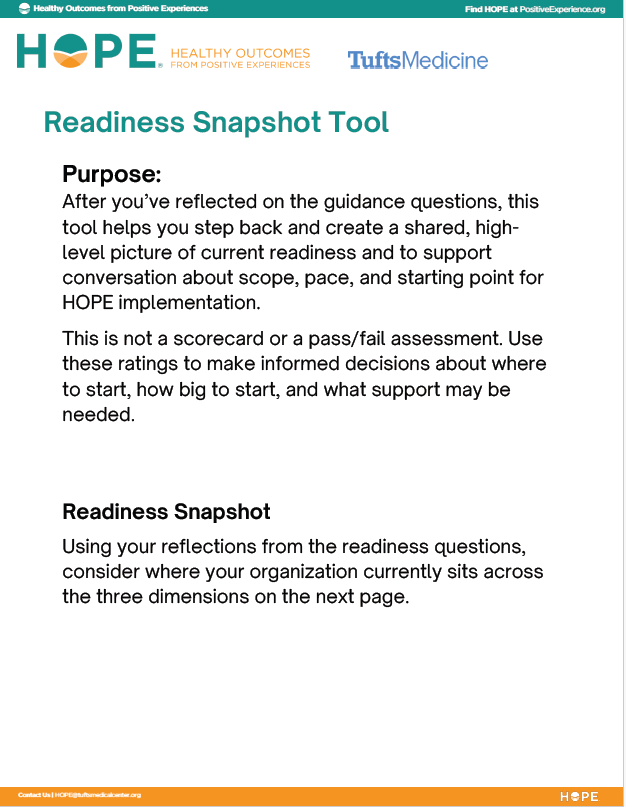
Readiness snapshot tool
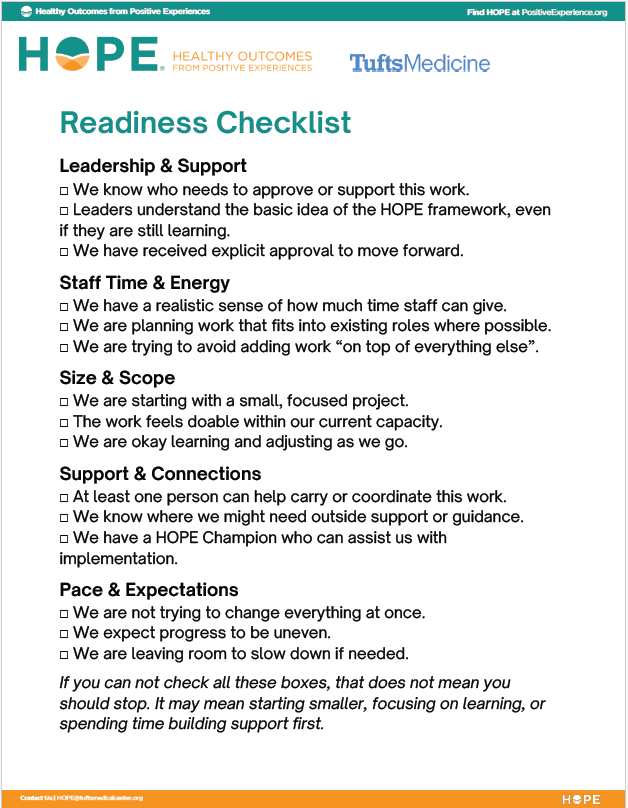
Readiness checklist
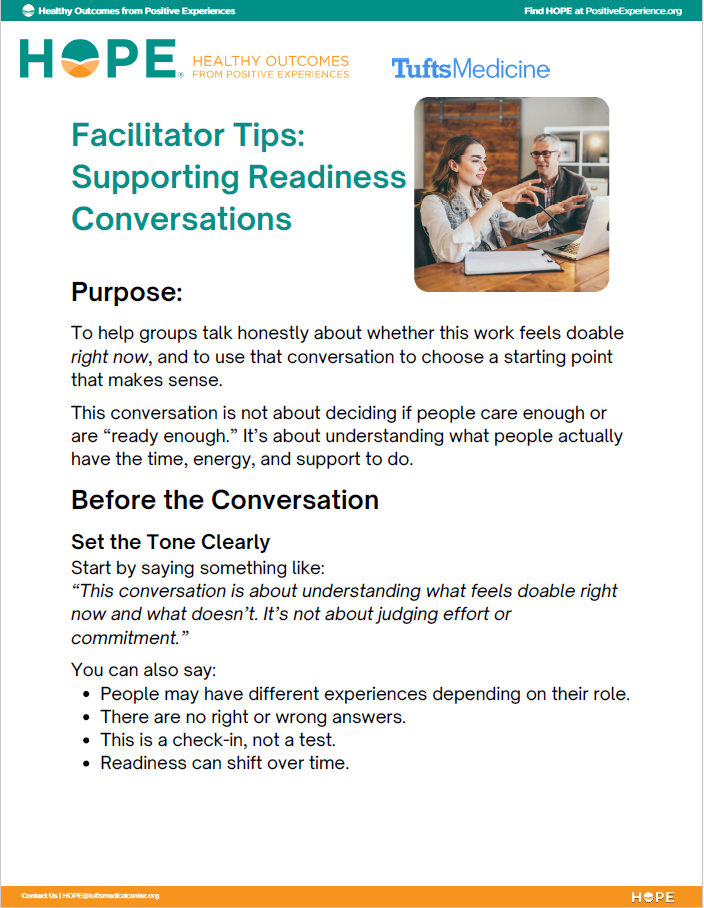
Facilitator tips: Supporting readiness conversations
Reflection prompts
These questions are intended to prompt discussion. There are no “right” answers.
- What signals tell us that now is the right (or not-yet-right) time to work on this issue?
- Where do we have strong support, and where might we encounter resistance or hesitation?
- What resources (time, people, data, relationships) are already available to us?
- What constraints do we need to name openly before moving forward?
- If we had to start smaller, what might that look like?
It can be useful to notice differences in perspective during these conversations. Variation often reveals important information about readiness across roles or levels of the organization.

In practice: Assessing readiness
Riverside Middle School is a mid-sized public middle school serving a diverse student population. Over the past several years, staff had become increasingly concerned about rising chronic absenteeism among 6th-grade students, as well as growing pressure on counseling and mental health services. At the same time, signs of staff burnout, particularly among those in student support roles, were becoming harder to ignore.
Several members of the group had previously attended HOPE-related trainings or webinars through conferences or professional development opportunities. They thought HOPE implementation might be a helpful approach to the issues of absenteeism, mental health needs, and staff wellness. Before identifying a specific project, they convened small group – an assistant principal, two school counselors, a social worker, and two teachers – to better understand whether this was the right moment to begin HOPE implementation and what scope would be realistic.
The concept of the Four Building Blocks of HOPE was familiar to a few of the members of the group, but no one at Riverside was a certified HOPE Facilitator or HOPE Champion at the time. The group named this openly and acknowledged that additional guidance would be important if they moved forward.
Their readiness conversation focused on understanding their current context. Participants talked candidly about:
- Leadership support, which was described as present but limited by competing priorities
- Staff bandwidth, which the group agreed was uneven across roles
- Emotional climate, described as high commitment paired with fatigue
- Oher pressures shaping daily work
This discussion led to a shared conclusion: Riverside could begin HOPE implementation, but only if it was small in scope, relational in focus, and supported by someone with deeper HOPE expertise. The group agreed that identifying a certified HOPE Champion would be a necessary step before moving into active implementation.
Keep going!
You’ve reflected on leadership alignment, staff capacity, and context. With that perspective in mind, the next step is to look closely at the data already available to you.
You’re ready to move on if:
- You have a sense of your team’s readiness and capacity
- You’ve identified strengths and potential challenges
- You know what support or adjustments may be needed