

Section 7: Develop a data collection plan

Is this section for me?
After developing an implementation plan, we recommend organizations continue onto this section for guidance on developing a data collection plan and establishing baseline data. However, some organizations may have a data collection plan and baseline data. Before beginning this section, let’s see if you have already completed it.
- Determined how often you will be collecting data? Who will be collecting it? How you will be collecting it?
- Agreed on a plan for reviewing the data?
- Communicated this plan to all involved individuals and organizations?
- Collected baseline data for each of your outcome measures?
If so, you’ve completed this step and can move onto the next section, Use PDSA Cycles, or you can read this section to confirm you are satisfied with your project.
Introduction to collecting data
This next step has two related but distinct goals: the development of the data collection plan and the collection of baseline data.
When you develop a data collection plan, you’ll decide how, when, and by whom data will be collected. This helps teams:
- Be clear about what information they are gathering
- Avoid confusion or duplication
- Reduce burden on staff
- Make sense of change over time
A data collection plan does not need to be complicated. It simply answers a few practical questions and provides a road map for anyone participating in data collection to follow:
- What data are we collecting?
- Who is collecting it?
- When will it be collected?
- How often will it be collected?
- How will it be collected?
- How will it be reviewed?
Good data collection plans are clear, simple, and flexible. You can adjust them as you learn.
Baseline data is the information you gather before testing changes. It helps you understand current conditions and provides context for later learning. In other words, it gives you a starting point. Without it, it’s hard to know whether changes are actually leading to improvement.
How this step fits into the larger QI process
Developing a data collection plan and establishing baseline data comes after you have chosen an implementation project, developed an aim statement, and chosen outcome measures. This step bridges planning and action.
Guidance and questions to ask
Clarify what data will be collected
Start with the measures you have already identified. Determine:
- What information you need to collect for each measure
- What this data looks like in practice (i.e., who collects it, when, how)
- Where it will be recorded for easy tracking (e.g., spreadsheet, database, Electronic Health Record report)
Decide how data will be collected for this project
Keep data collection as simple as possible. Clarify:
- Whether this data is collected through forms, logs, surveys, observations, or in some other way?
- Is this data already being collected in some way?
- If so, will that suffice for this project?
- If not, do we need to adjust an existing process or develop a new one?
Be clear about roles
Clear roles reduce confusion and missed data. Consider:
- Who is responsible for collecting the data?
- If needed, who is responsible for recording it for tracking?
- Who will review it?
- Who needs to see it?
Keep it simple and realistic
Data should support learning, not create stress. Before finalizing your plan, pause and ask:
- How often does this data need to be collected?
- How often will you look at it?
- Does this schedule feel realistic within the work?
- What will this data help us learn?
Establish baseline data
Once your data collection plan is finalized, you can identify or collect your first data point: baseline data. In some cases, this may involve collecting new information before implementation begins. In other cases, baseline data may already exist if you are using measures your organization routinely collects.
By first reporting collecting baseline data, you can track if your changes are making a difference or if things are staying the same. Whether the data is newly collected or pulled from existing sources, follow the process outlined in your data collection plan, including how the data will be recorded and tracked over time.
Tools and templates
Here are a few additional, optional, tools that might help as you work through the Guidance and Questions to Ask.
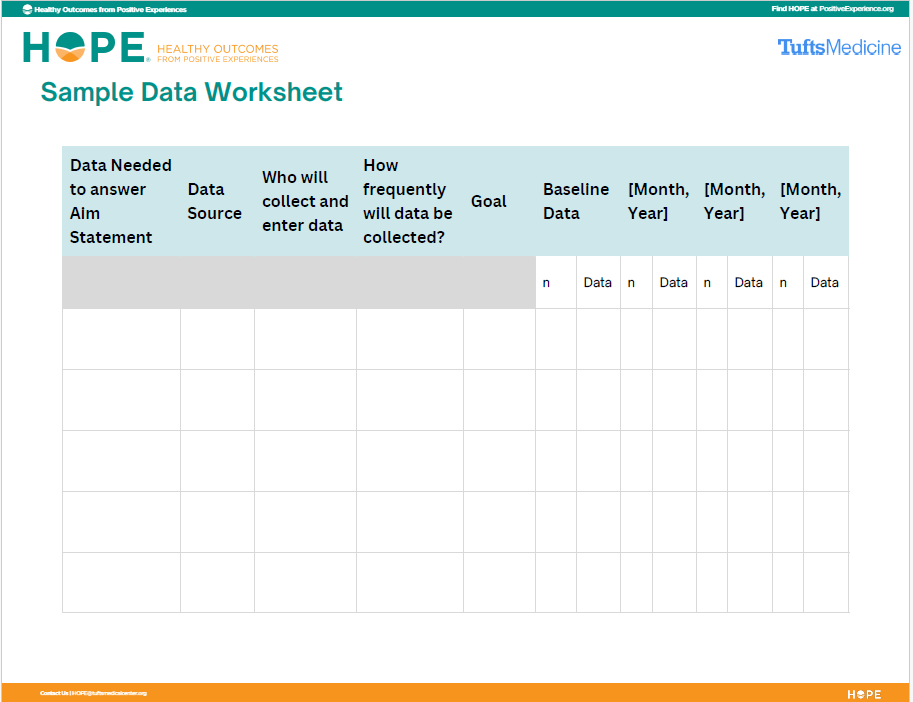
Sample data worksheet
Reflection prompts
After collecting your baseline data, consider:
- What does this data tell us right now?
- What patterns do we see?
- If we made progress towards our aim statement, how would we expect this data to change the next time we look at it?
- What additional questions do we have?
In practice: Developing a data collection plan
At this point, Riverside Middle School had:
- A clearly defined implementation project (HOPE-aligned intakes and referrals),
- A written aim statement,
- An agreed-upon set of measures (attendance, student belonging, staff well-being, and process indicators).
They now needed to decide how, when, and by whom data would actually be collected during implementation. They also needed a clear picture of where things were starting.
Riverside approached data collection as a practical planning task, not a separate evaluation activity. During a working meeting, the group focused on three questions:
- Who already touches this information?
- Where can data collection fit into existing routines?
- What is the minimum we need to learn?
They mapped each measure to a clear plan:
- Attendance data would be pulled monthly by the front desk staff using existing reports.
- Mentor check-ins would be logged using a simple shared form completed by mentors after each interaction.
- Student belonging would be assessed using a brief scale – The School Belongingness Scale – and administered by counselors during the student’s first meeting and a meeting in May.
- Staff well-being would be measured using the Professional Quality of Life scale, offered voluntarily to staff directly involved in implementation.
For each data point, Riverside identified who was responsible, how often data would be collected, and where it would be stored.
| Data | Who is responsible | How often | Where it will be stored |
|---|---|---|---|
| Attendance data | Front desk staff person will pull and give to school counselor | Monthly | School counselor will add to de-identified excel spreadsheet |
| Mentor check-ins | Mentors | After each check-in (weekly or more often) | Excel sheet connected to online form |
| Student belonging | School counselor | Once at first appointment and once in May | Raw data in student’s chart; composite score on de-identified excel spreadsheet |
| Staff well-being | Assistant principal | Once at project onset and once in May | Composite score on de-identified excel spreadsheet |
| Mental health referrals among those with attendance concerns | School counselor | Monthly | De-identified excel spreadsheet |
The group agreed that monthly review was sufficient for learning and adjustment.
After determining their data collection plan, they established baseline data for each measure. They gathered the following baseline information:
- Attendance baseline: Attendance rates for identified 6th-grade students were pulled for the previous three months.
- Referral baseline: Counselors reviewed referral logs to understand how often attendance concerns had escalated to mental health referrals prior to implementation.
- Student belonging baseline: Counselors administered the belonging measure to participating students during an existing check-in.
- Staff well-being baseline: The ProQOL was offered to counselors, the social worker, and mentors involved in the project, with clear communication that results would be reviewed only in aggregate.
Establishing baseline data served two purposes. First, it gave Riverside a starting point for comparison. Second, it helped the team align what “normal” looked like before changes were introduced.
Only after baseline data was collected did Riverside begin their first PDSA cycle. This sequencing helped ensure that learning from implementation was grounded and interpretable.
Keep going!
It’s time to begin implementation thoughtfully and in small steps. As you implement, you’ll test changes in ways that help you learn as you go.
You’re ready to move on if:
- You know what data you will collect and how
- Your process feels manageable within your existing workflow
- Your team understands their role in data collection