

Section 6: Develop your implementation plan

Is this section for me?
After choosing outcome measures and data sources, we recommend organizations continue onto this section for guidance on developing an implementation plan. However, some organizations may already have an implementation plan. Before beginning this section, let’s see if you have already completed it.
- Written an action (or implementation) plan that outlines tasks and a timeline for completion?
- Integrated your identified outcome measures into the plan?
If so, you’ve completed this step and can move onto the next section, Use PDSA Cycles, or you can read this section to confirm you are satisfied with your data collection plan.
Introduction to writing your implementation plan
An implementation plan helps teams move from intention to action. Implementation plans:
- Make the work concrete and visible
- Help teams think through what is actually required to move forward
- Identify needed resources, dependencies, and timing
- Build evaluation into the work instead of adding it later
A good implementation plan does not need to be complex. Strong plans are made up of small, workable steps that:
- Focus on what needs to happen first
- Assign clear responsibility
- Identify what support or resources are needed
- Include simple ways to check whether steps are happening as planned
Planning at this level helps teams avoid feeling overwhelmed and supports steady progress.
How this step fits into the larger QI process
By the time you reach this step, you will have already clarified readiness, reviewed data, selected an implementation project, written an aim statement, and identified how progress will be measured. The implementation plan brings those pieces together into a clear, workable path forward.
Guidance and questions to ask

Ground in what you’ve already decided
Before outlining implementation steps, it helps to reconnect to the decisions you’ve already made. This keeps planning focused and prevents the plan from drifting into activities that don’t clearly support your aim. Revisit your implementation project and reason for selecting it, aim statement, and measures you plan to track. Discuss:
- What needs to change for this aim to be achieved?
- What does this change look like in day-to-day work?
Grounding the plan in these decisions helps ensure that each step is purposeful and aligned.

Break the work into small steps
Implementation often feels overwhelming when teams try to plan everything at once. Breaking the work into small, manageable steps makes it easier to begin, learn, and adjust.
Rather than planning the entire project, ask:
- What step can we take in the next week?
- What comes next after that?
- Which steps depend on something else happening first?
If the step has multiple parts and requires multiple things, consider breaking it down further.

Be clear about roles and responsibility
Clear roles help implementation move more smoothly and reduce confusion or duplicated effort. Even small steps benefit from clarity about who is doing what. For each step, decide:
- Who will lead this?
- Who else needs to be involved?
- Who needs to know this is happening?
Spending time here can prevent misunderstandings later and support accountability without adding burden.

Think through resources and support
Every step requires some level of support, even if it’s minimal. Naming needs early helps teams plan realistically and avoid unnecessary delays. Consider:
- What do we need to make this step possible?
- Do we need time, materials, approvals, or coordination?
- Is there existing support or infrastructure we can use?
This step helps teams work within real constraints rather than planning in the abstract.
Build evaluation into the plan
Evaluation should not be a separate activity added later. It works best when it is planned alongside implementation and embedded into the steps themselves. As you plan each action, think about how you will know whether it happened and whether it contributed to progress toward your aim. This keeps evaluation practical and closely connected to the work. Decide how you will know this step happened and what information will tell you whether things are progressing as intended.
Additionally, implementation planning is when you should be thinking through the practical realities of using the outcome measures you identified for your project. Some data may already exist and be easy to access. Other measures may need to be developed, refined, approved, or coordinated across roles or systems. For each of the measures you plan to use in your project, consider:
- Does this measure already exist, or does it need to be created or adapted?
- Do we need permissions, approvals, or data-sharing agreements to access it?
- Who will be responsible for collecting, pulling, or compiling the data?
- How often will this data be available?
- Is there a lag between when the step happens and when we can review the data?
Naming these details early helps avoid delays later and sets realistic expectations about what learning will be available and when. It also helps integrate the evaluation into implementation rather than treat it as an extra task added on at the end.

Set realistic timelines
Timelines should support progress, not create pressure that undermines the work. Being realistic about pace helps protect staff capacity and sustain momentum. When setting timelines, consider:
- Staff workload
- Competing priorities
- The pace at which change can realistically happen
Plans can stretch teams slightly but should not set them up to fail. Remember that a plan that is slower but doable is more likely to succeed than one that fits into a desired but unrealistic timeframe.
Tools and templates
Here are a few additional, optional, tools that might help as you work through the Guidance and Questions to Ask.
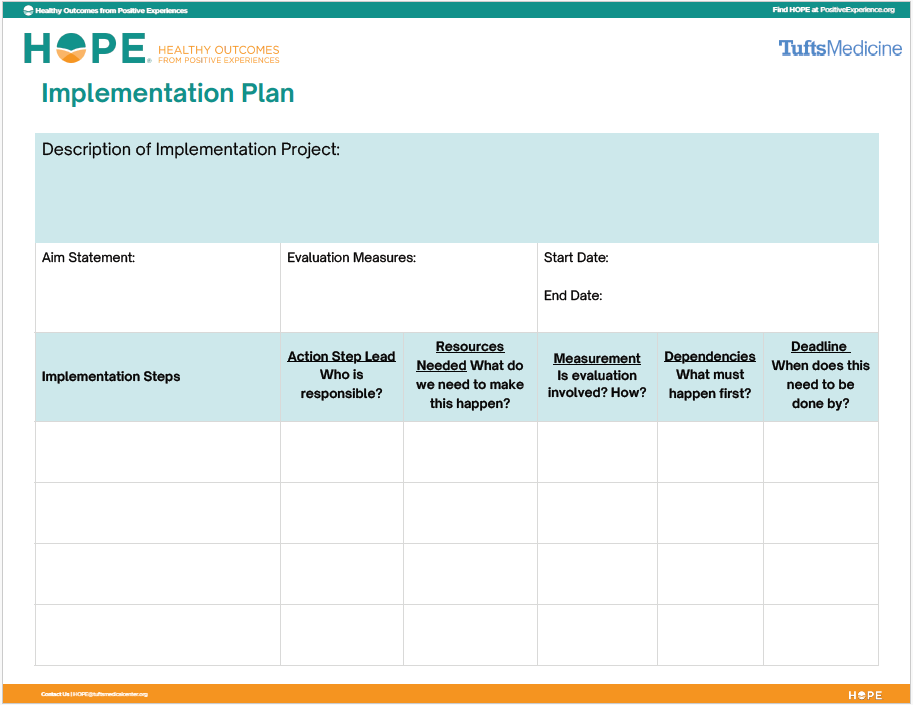
Implementation plan template
Reflection prompts
- Does each step feel clear and manageable?
- Do people know what they are responsible for?
- Where is evaluation built into the plan?
- Does the timeline feel realistic for everyone involved?
In practice: Developing an implementation plan
Riverside Middle School had defined their project, written an aim statement, and selected a small set of measures. They were ready to move into action.
Before implementation began, Riverside reached out through the HOPE National Resource Center’s website and connected with a local, certified HOPE Champion who had experience supporting implementating the HOPE framework in school settings. The Champion agreed to provide guidance during early planning, testing, and reflection.
Riverside outlined a short implementation plan covering January to May. The plan focused on actions that could begin immediately and be adjusted over time.
Key steps included:
- Identifying a small group of 6th-grade students meeting agreed-upon attendance criteria
- Adjusting initial conversations after attendance issues were recognized to emphasize relationship and strengths
- Pairing each student with a consistent adult mentor
- Beginning brief, weekly check-ins between the student and mentor
- Reviewing progress monthly with support from the HOPE Champion
Each step had a clear owner and included a simple way to track completion. The plan was intentionally flexible and expected to evolve through learning.
Keep going!
Now that your plan is outlined, you can start thinking about how and when you will collect data and interpret what you learn.
You’re ready to move on if:
- You have a clear plan for what you are going to do
- Roles and responsibilities are defined
- Your next steps feel manageable and actionable